Programme
Design and Italian creative business
Four-week intensive program, 28 days
You go home with one of your own products taken from drawing to shelf, and the method to do it again.
On this page
- What is and is not included
- Presentation
- Who it is for, and who it is not for
- The four modules, with the deliverable of each
- Day-by-day calendar
- The companies and places visited
- Before and after
- Who teaches
- What you receive at the end
- Where you sleep, how you get around, what it costs to live there
- Entry and Schengen days
- Frequently asked questions
- Related programs
- Format
- Intensive program, in person
- Duration
- 28 days, 4 weeks
- Hours
- 100 hours of in-person teaching · 25 hours a week, Monday to Friday
- Hours before and after
- 4 hours online before departure and 3 hours 45 after the return. These are not included in the 100. One hundred hours means one hundred hours in person
- Participants
- minimum 8, maximum 15
- Age
- over-18s only, eighteen years of age at the date of departure
- Language
[language of delivery: declared per intake]. Materials, templates and documents issued are always available in Spanish and English. A bilingual member of staff is present throughout- Site
[site: to be confirmed], plus one company visit away from the site- Season
- Italian intakes run February to April and June to October. Not in January, when Italian companies reopen after Epiphany
- Intakes
[intake: start and end dates, to be published on confirmation]. Dates may be subject to minor changes- Price
- Quotation on request, with a reply within two working days and the detail of what is included and what is not
- What is issued
- Certificate of attendance at the end of the stay, completion certificate at ninety days. No qualification, no academic credits
Request information · Download the program dossier (PDF) · I am bringing a group
The head of international programs replies within two working days. programas@istitutobelmonte.com · +39 [number] · Monday to Friday, 09:00-18:00 CET.
What is and is not included
| Included | Not included |
|---|---|
| 100 hours of in-person teaching, 25 a week | Return flights |
| At least 4 company visits, transfers included | Accommodation, a separate option with its own stated price |
| Entry dossier with template, 2 online sessions, language check | Dinners, weekend meals and meals on non-teaching days |
| 3 online appointments after the return, up to T+90, and the review of the implementation plan | Optional catalog experiences |
| Course notes, templates and software licences for the duration | Journeys not in the schedule |
| Urban transport pass for 4 weeks | Passport and, once in operation, the ETIAS authorisation |
| Lunch on the 20 teaching days | Accommodation security deposit, where required |
Accident and third-party liability cover for the stay, limits [limits: published once the policy is taken out] | Personal expenses |
| Airport pick-up on arrival | |
| 2 experience days at weekends, marked in the calendar | |
| Certificate of attendance and completion certificate, both with a verification code |
Presentation
Two objects that cost the same to make sell at different prices, and the difference is not in the material. It is in how the product was conceived, in what it says, in how it reaches the person who buys it. This program is about seeing that difference close up, in a country that has been building it for centuries, and then reproducing it on your own product.
You work on a real object, your own, from day one. In the first week you take it apart alongside six others, to find out where the price is actually formed. In the second you build the system of signs that holds it together, which is not the logo but everything around it. In the third you photograph it, write its product sheet and put a price on it that you can defend. In the fourth you take it in front of a panel that has never seen it and whose job is not to be kind.
Between one week and the next you go out. Into a company archive, where the history of a product is written in its mistakes before its successes. Into a place where a file becomes a printed object. Into a production site, following an order through to dispatch. Visits are not an add-on: each has an observation sheet filled in while walking and a debrief the same afternoon, and the questions for the owner are written the day before.
You do not need to be able to draw. You need a product, or a documented product idea, that you want to work on for four weeks without putting down.
Who it is for, and who it is not for
It is for university students between nineteen and twenty-four, often members of a young entrepreneurs' society, arriving as a group with their president. Many have a business, a shop or a workshop in the family, and the question they bring is a practical one: how do you get more for a product you already make. It is also for anyone with a personal project stuck at the drawing stage who wants to take it to a defensible form.
It is not for anyone looking for an academic program with credit recognition, because no credits are given. It is not for anyone looking for a professional qualification, because it is not one. It is not for anyone arriving without a product or a business to work on, because the whole program is built on each person's case and anyone without one spends four weeks watching other people work. It is not for anyone under eighteen.
Requirements. Eighteen years of age at the date of departure. A passport valid for at least six months beyond the expected return date — our rule, stricter than the legal minimum of three months beyond departure. Current university enrollment or a secondary school leaving qualification. English at a level equivalent to B1, checked in a twenty-minute conversation. A product or a documented product idea, described in the entry dossier.
The four modules, with the deliverable of each
Week 1 · Reading an Italian product — 25 hours Why two objects that cost the same to make sell at different prices. Material, process, history, sign, channel, and where the price is actually formed. Six real products brought into the room are taken apart, and a company archive is visited with the observation sheet in hand. You take home a six-page product analysis sheet, one page per price factor, with your own product positioned on each. In PDF and in editable original. You learn to break down perceived value, tell cost from price, observe a production process and take notes that are of use.
Week 2 · From sign to system — 25 hours A visual identity that holds across several media. Not the logo, the system. Workshop on a real mark, rotating review of twenty minutes per person, and a visit where the file becomes a printed object. You take home a mini design system in open files: mark, palette with codes, two type families, grid, three real applications (label, sheet, social), plus one page of written usage rules. You learn to hold visual consistency, prepare files for a printer, and give and take a review without taking it personally.
Week 3 · The product meets the market — 25 hours How an object becomes a sheet that sells, a photograph that convinces, a price that holds. Photo set in the room, lighting and styling included. Two company visits, one production and one retail, with the questions prepared the day before and the debrief the same afternoon. You take home a photo set of eight finished shots and a complete, publishable product sheet: title, description, specifications, dimensions, care, price with its justification. You learn to photograph a product, write to sell, and build a company visit instead of enduring it.
Week 4 · Project and defense — 25 hours Taking your own product to a concept you can defend in front of people who do not know it. Independent work with the tutor in the room, two timed dress rehearsals, final presentation of twelve minutes plus eight of questions in front of a panel including at least one outside practitioner. You take home a project dossier (analysis, system, product, sheet, price, first steps) and the recorded twelve-minute presentation. You learn to summarise, hold up under an awkward question, and close a piece of work by a deadline.
Day-by-day calendar
The five day types
A · Classroom day (5 teaching hours) 09:15 opening and re-reading of the previous day's submission · 09:30-11:00 first block, teaching and discussion of your own case · 11:00-11:15 break · 11:15-13:00 second block, guided workshop · 13:00-14:00 lunch, included · 14:00-15:45 workshop on your own case with rotating review · 15:45-16:00 submission of the day, ten lines on what changed.
B · Company day, out and back the same day (5 hours) 07:45 departure from the site · 09:00 arrival and welcome · 09:15-09:45 briefing with the company contact, who already holds the questions prepared the day before · 09:45-11:45 walk-through of the process on site, with the observation sheet filled in as you go · 11:45-12:45 session with the people who do the work, not the people who describe it · 12:45-13:45 lunch · 13:45-15:15 debrief on site, comparison of sheets and a written group synthesis · 15:30 return.
C · Project day (5 hours) 09:30-11:00 independent group work, with the tutor present and silent unless asked · 11:00-11:15 break · 11:15-12:15 rotating review, twenty minutes per group · 12:15-13:00 technical block on request, topic chosen by participants the evening before · 13:00-14:00 lunch · 14:00-15:45 work and partial submission, uploaded before leaving.
D · Travel day with two stops (5 hours) 06:30 departure · 09:40 arrival in the city, luggage dropped · 10:30-12:30 first stop, visit and session · 12:30-14:00 lunch · 14:30-16:30 second stop · 17:00-18:00 one-hour debrief in the space hosting us.
E · Final submission day (5 hours) 09:30-10:45 two timed dress rehearsals · 11:00-13:00 presentations, twelve minutes plus eight of questions · 13:00-14:00 lunch with the panel · 14:00-15:00 individual feedback, ten minutes each · 15:00-15:45 close, certificates handed over and the calendar of follow-up sessions signed.
Hours count teaching time only.
-
—
airport pick-up, settling in, welcome dinner
-
5 h
opening, ground rules, entry dossiers presented one by one
-
5 h
guided teardown of six real products, first pass on the six price factors
-
5 h
visit with observation sheet, session with the archive keeper
-
5 h
where the price is formed, your product against the six taken apart
-
5 h
writing the analysis sheet. Submission 1
-
—
a day from the experience catalog, not counted in the hours
-
—
-
5 h
visual identity, why a logo alone does not hold
-
5 h
workshop on the real mark, rotating review of twenty minutes per person
-
5 h
where the file becomes an object, proofs and materials
-
5 h
building the mini design system, tutor alongside
-
5 h
written usage rules and three real applications. Submission 2
-
—
a day from the experience catalog, not counted in the hours
-
—
-
5 h
the sheet that sells and the price that holds, with the figures on your own product
-
5 h
product photo set, lighting, styling, eight shots
-
5 h
production and logistics site, followed from order to dispatch
-
5 h
how the product reaches the buyer, session with the people on the shop floor
-
5 h
writing the complete product sheet. Submission 3
-
—
-
—
-
5 h
final project opens, independent work with tutor
-
5 h
rotating review, first timed dress rehearsal
-
5 h
second dress rehearsal, cross stress test between groups
-
5 h
closing the project dossier
-
5 h
presentations, panel, feedback, certificates. Submission 4
-
—
Total 100 hours across 20 teaching days. The two weekend experience days are included in the price and are not counted in the 100 hours, any more than the online sessions before and after are. One hundred hours means one hundred hours in person.
The companies and places visited
We name only what is confirmed. Everything else is described by category, with its current status alongside. When a venue confirms, its name appears here.
| Day | Place | Status at 13/10/2026 |
|---|---|---|
| 18 | Nola, production and logistics site, via Boscofangone ASI zone lotto C8 | confirmed, it is one of the group's own sites |
| 4 | A company archive or museum | candidates identified, none contacted yet |
| 11 | A design studio or printworks | candidates identified, none contacted yet |
| 19 | A retail business | candidates identified, none contacted yet |
| 2-27 | Base classroom | [site: to be confirmed] |
A clarification we make before anyone else makes it. Most of the business places open to visits in Italy are company archives and corporate museums, not working factories. A company archive is the archive of a living business, with its documents and its mistakes, and it is worth the day it costs. But it is not a factory, and we do not call it one. Where the calendar has a working plant, it says which one.
Before and after
→ The method, applied to this program; its hours are not included in the hundred.
Who teaches
The program is taught by people who do this work every day. We state roles and competence, not names, because on the website we publish the function that answers rather than the person. In the documents handed to the institution bringing the group, the person responsible has a name, a contact and a signature.
Head of product design and identity systems. Teaches weeks 2 and 3. Builds identity and interface systems that have to hold across dozens of media and years of use, not across one presentation. Design engineer, product interface and content. Supports weeks 2 and 3 on application, product photography and video. External specialist in materials and production processes, on contract, with an internal teacher alongside. Teaches the materials part of week 1. We write it rather than leaving it out, because it is a competence we do not hold in-house and buy outside, as anyone does. Program director. Owns the syllabus, tests the modules, signs the certificates and answers for quality. This is the person you write to if something is wrong. Bilingual facilitator, in the room throughout. Not a simultaneous interpreter, which is a different profession. Rephrases, picks up the questions language embarrassment suppresses, and works with the groups.
The final presentation panel includes at least one practitioner from outside the Institute.

What you receive at the end
At the end of the in-person activities the Institute issues a certificate of attendance to anyone who attended at least 80% of the scheduled hours. The document carries the name, dates, sites, total hours, the list of modules with the hours of each, the attendance percentage recorded and a verification code.
Ninety days after the end, anyone who has submitted every module deliverable and the final implementation plan receives the program completion certificate, which lists each deliverable by name with the date it was submitted.
Both documents carry, printed on them, the same sentence you are reading here.
This program does not lead to any qualification with legal validity. Istituto Belmonte is a private training institute. Its programs do not confer qualifications with legal validity in Italy or in any other country and carry no academic credits. A certificate of attendance stating hours and content is issued at the end.
Academic recognition of these hours rests solely with the student's home institution. If that institution provides for it and appoints a tutor, we supply the syllabus, the hours and the attendance register in the format the institution requires.
The documents are issued in Italian, with a certified English translation attached at no charge.
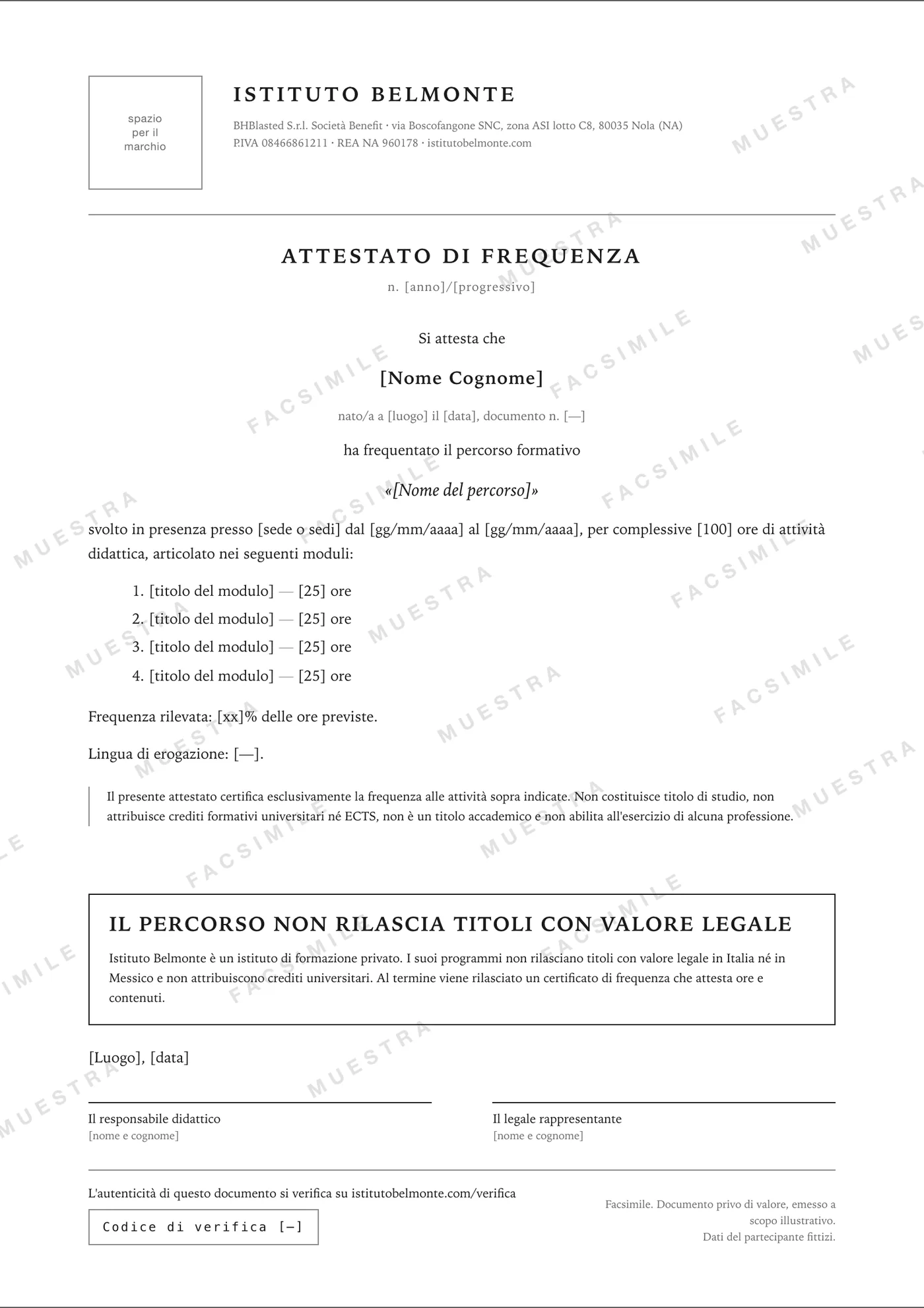
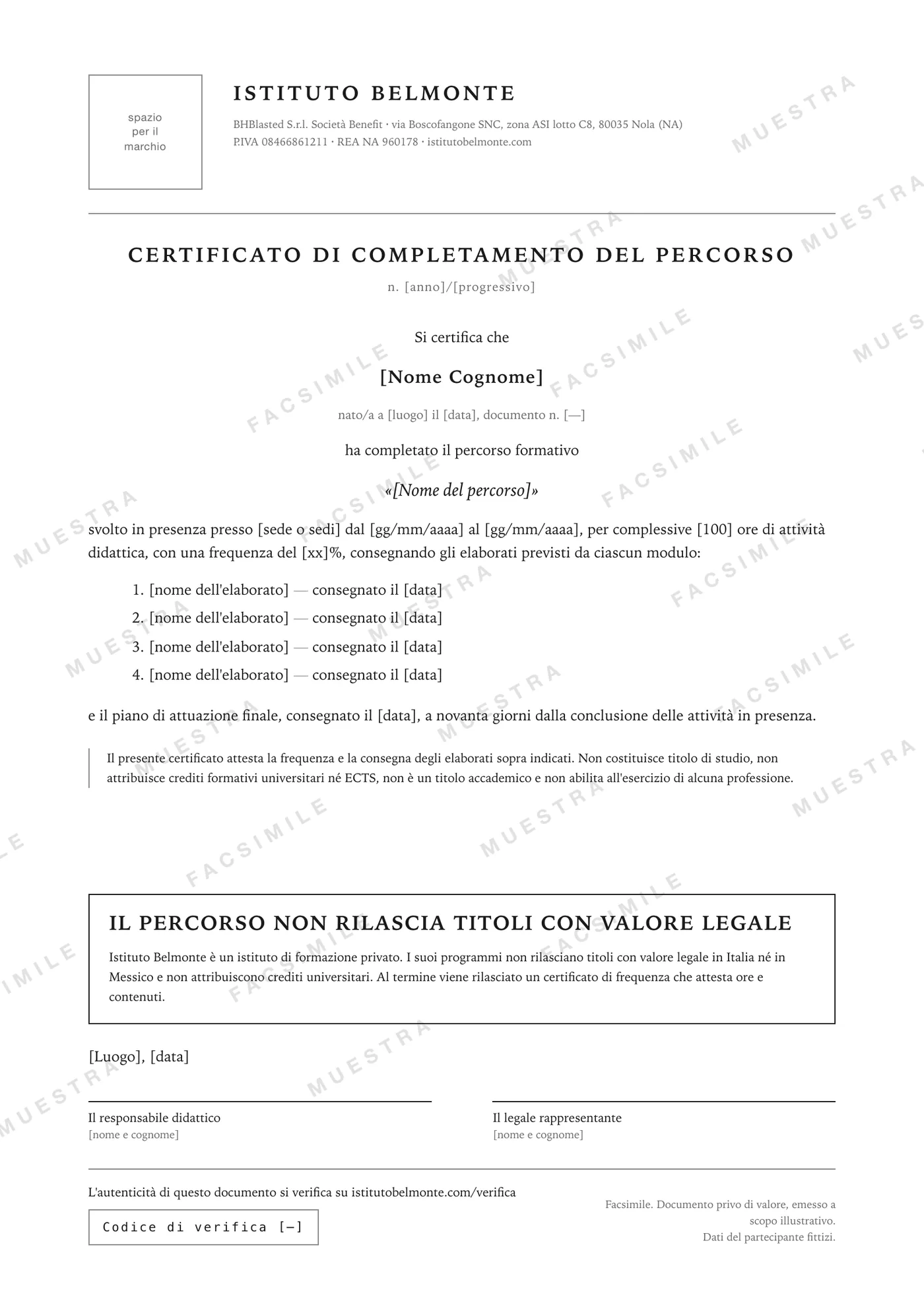
The documents are issued in Italian, the language of the issuing company. A certified English translation is attached on request, at no charge. The verification code will be entered at istitutobelmonte.com/verifica once the verification page is live, and will return name, program, dates and hours. Until then verification is done in writing, with a reply within two working days.
Where you sleep, how you get around, what it costs to live there
Accommodation is not included in the program price. It is a separate option with its own stated price. We say so plainly, because a price with accommodation buried inside it makes it impossible to see what the training actually costs.
The Institute offers a single room for the whole duration, on request, in arranged accommodation within walking distance or one short journey from the site. Anyone who prefers to arrange their own may do so, and in that case we ask for the address and a contact number before departure, because the person responsible for the group has to know where everyone is sleeping.
The program price does include an urban transport pass for the whole duration, lunch on teaching days and airport pick-up on arrival. It does not include dinners, meals at weekends or on non-teaching days, or personal expenses.
The accommodation provider may ask for a security deposit. The Institute does not collect it and it is not part of the price.
→ Accommodation and practicalities
Entry and Schengen days
For a stay of up to 90 days in any 180, nationals of the countries in Annex II to Regulation (EU) 2018/1806 — Mexico and Brazil among them — do not need a visa to enter the Schengen area. This program lasts fewer than 90 days, so no visa is required for it.
The 90-day count is cumulative across the whole Schengen area, not one country, and since 10 April 2026 the Entry/Exit System has recorded it automatically at the border, fully operational at all external crossing points of the 29 countries that use it. Anyone who has already travelled in Europe in the last six months may not have enough days left. This is checked before enrolling, not at the gate.
The ETIAS authorisation is not yet in operation. The European Commission will announce the start date several months in advance. When it does come into operation it will be at the student's expense, will cost EUR 20 and will be valid for up to three years or until the passport expires. It does not guarantee entry.
Your passport must be valid for at least three months beyond your intended departure from the Schengen area and have been issued within the previous ten years: that is the legal minimum, set by Article 6 of the Schengen Borders Code. We ask for six months beyond the expected return date, which is our own stricter rule and absorbs a rescheduled flight.
What we do. We prepare a named letter of admission with duration, syllabus, weekly hours and the type of final document, in the format required. What we do not do. We do not obtain visas, we do not guarantee them and we do not handle consular applications. The decision rests solely with the consulate.
→ Entry, visas and residence permit · → European Commission, EES · → European Commission, ETIAS
Frequently asked questions
Does the program carry academic credits? No. The program carries no academic credits, neither Italian CFU nor ECTS, and it is not a qualification. Recognition of the hours is possible only if your own institution provides for it and appoints a tutor: in that case we supply the syllabus, the hours and the attendance register in the format required.
Do I need a visa? Not if the stay remains under 90 days in any 180 and you hold a passport from a country in Annex II to Regulation (EU) 2018/1806, which includes Mexico and Brazil. The count is cumulative across the whole Schengen area. See the entry block above.
Can I take part at seventeen? No. The program is open only to people who have turned eighteen by the date of departure, and age is checked against the passport at pre-registration. This applies equally to anyone turning eighteen during the stay.
Do I need to speak Italian? No. The requirement is English at a level equivalent to B1, checked in a twenty-minute conversation rather than by certificate. A bilingual member of staff is present throughout, and materials, templates and documents are always available in Spanish and English.
How do I pay, and can you invoice? A 30% deposit on confirmation, the balance thirty days before departure. International bank transfer, and for groups an invoice made out to the institution. No payment to personal accounts, for any reason. If an institution is paying, the contracting party is the institution and not the student, and the procedure is different: → I am bringing a group.
What if I have to withdraw? The refund terms are written into the contract and onto the terms page, with the deadlines and the percentages. They are not discretionary.
Do I need to be able to draw? No. Drawing ability is not assessed. You work on an existing product or a documented idea, and drawing tools are used only enough to make an intention legible. People who draw well start ahead on one thing, speed, and behind on another, because they tend to fall in love with the mark before they have understood the price.
Can I bring the physical product to Italy? Yes, and it is recommended. The program works better with the object on the table. Anyone who cannot bring it submits ten photographs in the entry dossier, taken to the scheme we provide, plus the dimensions and the materials sheet. The print proofs and the week 3 photo set go ahead anyway, on a sample or a reproduction.
28 days · 100 hours in person · 25 hours a week · 8-15 participants · over-18s only · [site: to be confirmed] · [intake: start and end dates, to be published on confirmation] · quotation on request · certificate of attendance and completion certificate, no qualification and no academic credits.
Request information · Download the program dossier (PDF) · I am bringing a group
Related programs
AI applied to business processes, 28 days, 100 hours. Same format, different subject. Digital business and multichannel commerce, 28 days, 100 hours. Extended program, 85 days, 180 hours, with a design specialization and a commissioned project.
Bringing a group? The procedure is different, the contracting party is the institution rather than the student, and there is a document to take to your office. → I am bringing a group
Istituto Belmonte is BHBlasted S.r.l. Società Benefit, VAT 08466861211, registered with the Companies Register of [place] under REA no. NA 960178. European Union trade mark no. 019120355. Policy [insurer] no. [number], limits [limits: published once the policy is taken out]. This program does not lead to any qualification with legal validity and carries no academic credits.
Let us talk about this route
We answer within two working days with the dates, the day by day program and the quotation.