Admissions
Entry, visas and residence permit

On this page
- In three lines
- The two nationalities we work with most, with their own source
- The 90 days are not your 90 days
- What changed at the border: the EES
- ETIAS: not in operation, and no date
- What is required in any case, visa or no visa
- Beyond 90 days: why we do not sell longer programs
- Residence permit (permesso di soggiorno)
- The official sources, one by one
Last updated: 13 October 2026. This page sets out rules and procedures that change. Every statement has its official source and the date we read it alongside. If a source has changed since that date, the source prevails.
In three lines
For a stay of up to 90 days in any period of 180, nationals of the countries listed in Annex II to Regulation (EU) 2018/1806 do not need a visa to enter the Schengen area, and therefore Italy. Every Institute program lasts fewer than 90 days, by design. A valid passport is required, and so are remaining days, which is the part almost nobody checks before booking a flight.
The European Commission states the rule as follows:
«Non-EU nationals need a visa to enter the Schengen area for a visit of up to 90 days in any 180-day period.» — and refers to Annex II of Regulation (EU) 2018/1806 for the list of countries whose nationals are exempt.
→ European Commission, Schengen visa policy · Regulation (EU) 2018/1806, Annex II
The two nationalities we work with most, with their own source
| Nationality | Position | Official source, read 13 October 2026 |
|---|---|---|
| Mexico | In Annex II. The Italian Embassy in Mexico City states: «Los/las ciudadanos/as mexicanos/as están exentos de solicitar la visa cuando viajen al espacio Schengen por un máximo de 90 días en el arco temporal de 180 días.» | Italian Embassy, Mexico City — Visas |
| Brazil | In Annex II, and covered by a bilateral EU-Brazil short-stay visa waiver agreement in force since 1 October 2012, amended with effect for Brazil from 1 March 2026 so that the count reads «90 days in any 180-day period». The Italian Embassy in Brasília states: «I cittadini brasiliani sono esenti dal visto d'ingresso in Italia per viaggi con permanenza fino a 90 giorni ogni 180» [Brazilian nationals are exempt from an entry visa for Italy for stays of up to 90 days in any 180], for purposes including study | Italian Embassy, Brasília — Visti · Decreto no. 12.864 of 2 March 2026, Brazil |
For any other nationality, the answer is in Annex I and Annex II to Regulation (EU) 2018/1806, and we will not guess it. If your group holds passports from other countries, send us the list of nationalities with the request and we will set out the position for each one in writing, with the source, before any document is issued.
The 90 days are not your 90 days
This is the point that ruins the most trips, so it goes here rather than at the end.
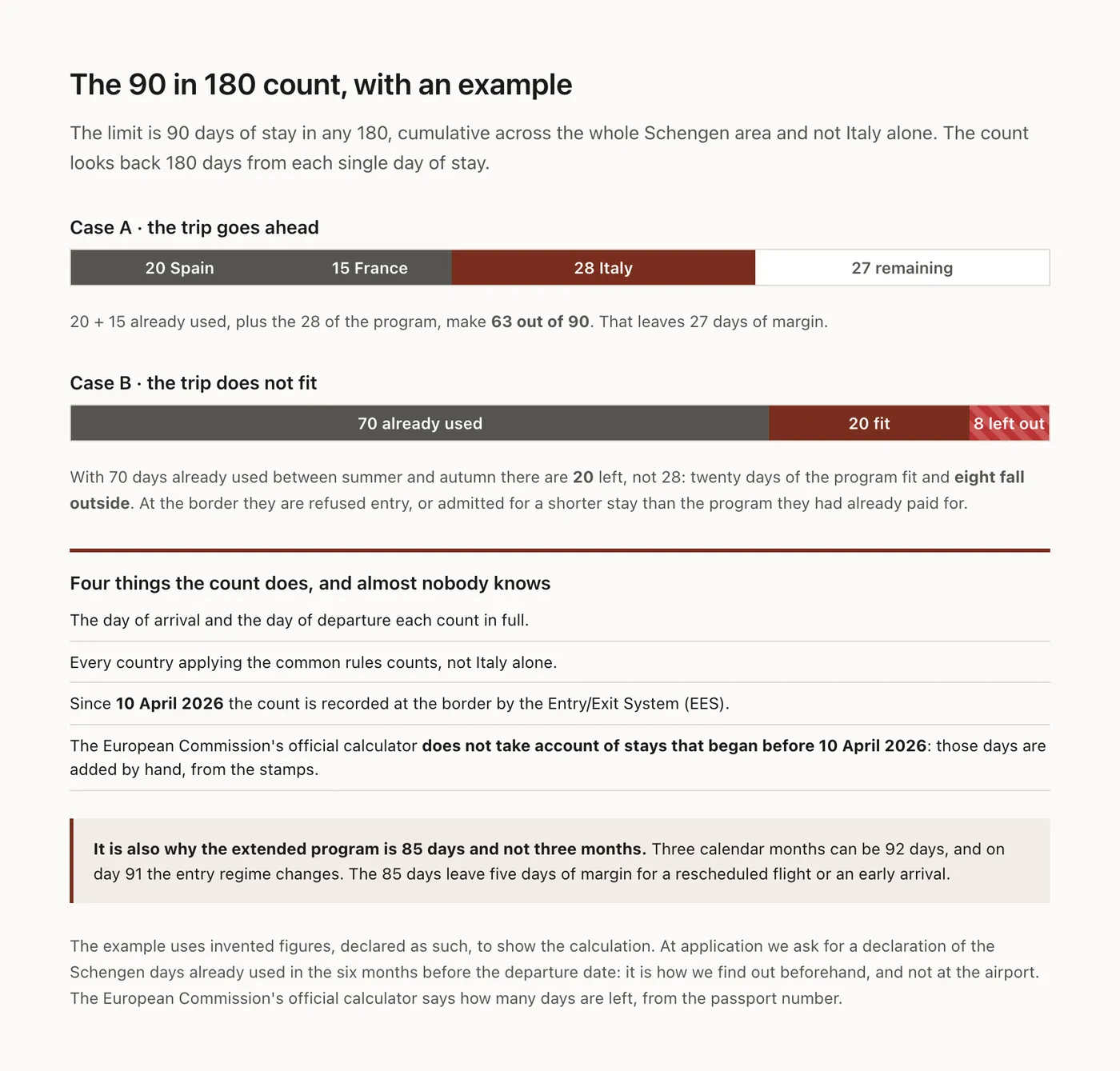
The count is cumulative across the whole Schengen area, not per country, and it looks back 180 days from each single day of stay. Inside that window sit every trip to every country applying the common rules: a week in Madrid, four days in Paris, a weekend in Amsterdam. The day of arrival and the day of departure each count in full: the Schengen Borders Code provides that «the date of entry shall be considered as the first day of stay and the date of exit shall be considered as the last day of stay».
An example. A student spent 20 days in Spain in July and 15 days in France in September, 35 in total. In February they want to attend a 28-day program in Italy. If the 180-day window preceding their last day in Italy still contains those 35 days, their count reaches 63 and the trip goes ahead. Had they spent 70 days in Europe between summer and autumn, in February they would have 20 days left, not 28: they would be refused entry at the border, or admitted for a shorter stay than the program they had paid for.
How to check, before enrolling. The European Commission publishes an official calculator that returns the number of days remaining, from the passport number. → European Commission, «Check how long you can stay»
One thing the calculator does not do, and the Commission says so on that same page: it does not take account of stays that began before 10 April 2026. Anyone who travelled in Europe before that date must add those days by hand, from the stamps in their passport.
What we ask for. At application we ask for a declaration of the Schengen days already used in the six months before the departure date. It is not a check on anyone: it is how we find out beforehand, rather than at the airport, that a participant does not have the days.
What changed at the border: the EES
The Entry/Exit System (EES) electronically records every crossing of the external borders by non-EU nationals, with a facial image and fingerprints in place of the passport stamp.
It started on 12 October 2025 on a progressive basis, and according to the European Commission that progressive implementation ended on 9 April 2026: from 10 April 2026 the system is fully operational at all external border crossing points of the 29 countries that use it. Cyprus and Ireland continue to stamp passports by hand.
What this changes in practice for someone traveling today:
- The 90-day count is automatic. An overstay no longer passes unnoticed, and whoever overstays is recorded as having done so.
- The first crossing takes longer, because the face and fingerprints are captured. Later trips are quicker.
- A biometric passport is not required to enter, but it is required to use the self-service kiosks available at some airports.
→ European Commission, what the EES is · Official FAQ, including the full-operation date
ETIAS: not in operation, and no date
A start date for ETIAS, the travel authorisation for visa-exempt travellers, is widely quoted. That date does not exist. The official European Commission page, read on 13 October 2026, states:
«ETIAS is currently not in operation and no applications for travel authorisations are collected at this point. The European Union will inform about the specific date for the start of ETIAS several months prior to its launch.»
That is: the system is not live, no applications are being taken, and the date will be announced several months in advance. Anyone selling or promising an ETIAS application today is selling something that cannot be done.
When it does come into operation, these are the official figures already published:
| Item | Official figure |
|---|---|
| Cost | EUR 20, with exemptions for some categories |
| Validity | up to three years or until the passport expires, whichever comes first |
| Link to the document | tied to the passport: new passport, new authorisation |
| Countries | 30 European countries, multiple entries, short stays of up to 90 days in 180 |
| Response times | most within minutes; otherwise a decision within four days, extendable by 14 if documents are requested and up to 30 if an interview is required |
| What it does not do | it does not guarantee entry: at the border an officer still checks the conditions |
→ European Commission, what ETIAS is
When the date is announced we will update this page and the update date at the top will show it. Until then there is no date here, because there is none.
What is required in any case, visa or no visa
Being exempt from a visa is not being exempt from checks. The entry conditions remain those of Article 6 of the Schengen Borders Code, Regulation (EU) 2016/399, and they can be checked one by one at the border.
| Item | Detail |
|---|---|
| Passport | valid for at least three months beyond the intended date of departure from the Schengen area, and issued within the previous ten years |
| Purpose and conditions of the stay | to be justified. For our programs we supply a letter of admission with dates, site, hours and content |
| Means of subsistence | for the duration of the stay and for the return |
| Return booking | the return ticket is the simplest evidence of the dates |
| Medical insurance | not an entry condition for visa-exempt travellers, but it is our condition of participation. The policy is included in the program, with the limits published once the policy is taken out and attached to the contract |
One of our own requirements is stricter than the law, and we say which. The legal minimum is three months of residual passport validity beyond departure. We ask for six months beyond the expected return date. That is our rule, not a legal one: it absorbs a rescheduled flight without putting anyone at the border with a passport that has gone out of range.
As a benchmark for cover: for study and training courses of up to 90 days the information sheet of the Italian Consulate in Mexico City requires, from those who do need a visa, minimum medical cover of EUR 30,000 for emergency hospital treatment and repatriation. That is the floor we measure ourselves against.
→ Schengen Borders Code, Article 6 ·
Beyond 90 days: why we do not sell longer programs
This is the part of the page we would rather not write, and we are writing it.
Beyond 90 days the exemption ends and a national type D visa for study or vocational training is required. The official information sheet of the Italian Consulate in Mexico City, a document dated September 2023 and still published as at today's date, requires the course to be run by accredited bodies and requires two specific documents to be attached to the application. The sheet is written in Spanish and we reproduce it as it stands:
«A) COPIA DE LA ACREDITACIÓN REGIONAL DE LA ESCUELA COMO CENTRO DE FORMACIÓN PROFESIONAL B) COPIA DE LA AUTORIZACIÓN REGIONAL QUE EL CURSO EN CUESTIÓN SE LLEVA A CABO EN EL MARCO DE UN PROGRAMA DE FORMACIÓN AUTORIZADO POR LA REGION CORRESPONDIENTE»
[A) A copy of the regional accreditation of the school as a vocational training center. B) A copy of the regional authorisation showing that the course in question takes place within a training program authorised by the relevant Region.]
We do not hold those two documents today. Istituto Belmonte is a private training institute and is not a vocational training center accredited by an Italian Region. Without those two attachments the visa application is incomplete, and the program could not take place.
So we do not put programs longer than 90 days in the catalog, we do not sell them and we do not announce them. The longest program we offer lasts 85 days, five below the threshold, and that is why we count it in days and not in months: three calendar months can be 92 days, and at 91 the regime changes.
From the same consular sheet, for anyone taking that route with another provider: the application is filed at most 180 and at least 15 days before the course starts, the form is type D above 90 days, the letter of acceptance must state duration, syllabus, type of final certification, language and at least 20 teaching hours per week, and the visa costs EUR 50.
We have not verified whether an Italian consulate in Brazil, or in any other country, requires the same two attachments. It makes no difference to what we sell, because above 90 days we sell nothing, and we are not going to assume it.
→ Information sheet, Italian Consulate in Mexico City, study and vocational training visas (PDF, September 2023) · → Interministerial Decree 850 of 11 May 2011, §15 (PDF, Italian) · → Consular appointment booking, prenotami.esteri.it
Residence permit (permesso di soggiorno)
It does not apply to our programs, and we explain it anyway because it is the question that comes next.
Anyone entering Italy on a national type D visa must apply for a residence permit within eight working days of entry. This is set out in Article 5(2) of Legislative Decree no. 286 of 25 July 1998, read on Normattiva on 13 October 2026. The Italian text is the one that counts:
«Il permesso di soggiorno deve essere richiesto, secondo le modalità previste nel regolamento di attuazione, al questore della provincia in cui lo straniero si trova entro otto giorni lavorativi dal suo ingresso nel territorio dello Stato ed è rilasciato per le attività previste dal visto d'ingresso o dalle disposizioni vigenti.»
[The residence permit must be applied for, in the manner laid down in the implementing regulation, to the questore of the province in which the foreign national is present, within eight working days of their entry into the territory of the State, and it is issued for the activities provided for by the entry visa or by the rules in force.]
They are eight working days, not eight calendar days. With a Friday arrival, or around a public holiday, the difference runs to nearly two weeks. We write it because the short version, «eight days», circulates everywhere and is the one that makes people miscalculate.
Anyone entering without a visa, for a stay of up to 90 days, does not apply for a residence permit. What applies instead is the declaration of presence, which for anyone staying in licensed accommodation is discharged by the accommodation itself at check-in.
→ Legislative Decree 286/1998, Article 5, text on Normattiva
The official sources, one by one
There is nothing on this page that cannot be verified independently. This is where to verify it.
| Source | What it says | Read on |
|---|---|---|
| European Commission — Schengen visa policy | The 90/180 rule and where the country lists are | 13/10/2026 |
| Regulation (EU) 2018/1806, Annex II | The list of countries whose nationals are visa-exempt, including Mexico and Brazil | 13/10/2026 |
| Italian Embassy, Mexico City — Visas | The exemption for Mexican nationals and the start of the EES | 13/10/2026 |
| Italian Embassy, Brasília — Visti | The exemption for Brazilian nationals, purposes including study | 13/10/2026 |
| Decreto no. 12.864 of 2 March 2026 (Brazil) | The EU-Brazil agreement and the 90/180 wording | 13/10/2026 |
| Italian Consulate, Mexico City — study and training visa requirements (PDF) | What a type D visa requires, attachments included. Document dated September 2023 | 13/10/2026 |
| European Commission — ETIAS | That ETIAS is not in operation and the date will be announced months in advance | 13/10/2026 |
| European Commission — EES | What it is, which countries, how it works | 13/10/2026 |
| European Commission — remaining-days calculator | How many days are left, from the passport | 13/10/2026 |
| Normattiva — Legislative Decree 286/1998, Art. 5 | The eight working days for the residence permit | 13/10/2026 |
| Schengen Borders Code, Reg. (EU) 2016/399 Art. 6 | Entry conditions and how the days are counted | 13/10/2026 |
| prenotami.esteri.it | Where consular appointments are booked | 13/10/2026 |
What we do, and what we do not do
We do not obtain your visa. A visa is issued by a consulate, which is the only body that decides. We have no channels and no shortcuts, and anyone saying otherwise is saying something untrue.
What we do is one thing, and we do it properly: we prepare the letter of admission in the format the consulate requires, with duration in days, exact dates, syllabus, weekly hours, language of delivery, site and the type of document issued at the end. If the consulate asks for anything further, we prepare it within two working days.
For questions about this page, the head of international programs replies within two working days. programas@istitutobelmonte.com · Monday to Friday 09:00-18:00 CET.
This program does not lead to any qualification with legal validity. Istituto Belmonte is a private training institute. Its programs do not confer qualifications with legal validity in Italy or in any other country and carry no academic credits. A certificate of attendance stating hours and content is issued at the end.